Building Reliable AI Search with Expert Evaluation
This article outlines how the micro1 intelligence platform was used to evaluate our own AI search tool in real recruiter workflows, achieving 84.7% success while uncovering critical gaps in ranking, relevance, and decision quality
%20(2).png)
%20(1).png)
.avif)
.svg)
Build trust in your AI agents
Overview
micro1 operates at the center of high-volume global recruitment, where quickly identifying the right candidates is critical. To support this, we developed AI Candidate Search, a system that allows recruiters to find candidates using natural language queries. The system interprets recruiter intent and sources candidates in accordance to the skills, experience, and specific background described in the query.
While traditional evaluation approaches focus on automated metrics such as keyword match or precision, these signals often fail to capture how recruiters actually interact with search results. In practice, recruiting is a decision-making workflow not just a retrieval task. Factors like candidate ordering, true profile relevance, and adherence to hard constraints play a critical role in determining whether a search is truly useful.
To address this, micro1 leveraged our intelligence platform to design a structured human evaluation framework with an embedded Quality Control (QC) layer. This system provides consistent visibility to ensure that evaluations reflect real recruiter behavior, prevent evaluation drift, and enable consistent benchmarking across model versions. By combining quantitative metrics with qualitative feedback, the framework captures both system performance and user experience.
Over a 4-week period, 5 professional evaluators conducted 417 real-world searches. The system demonstrated strong baseline performance, with 84.7% of searches considered at least partially successful and an average of 7.8 relevant candidates in the top 10 results. At the same time, human evaluation surfaced gaps in ranking, retrieval, and transparency that would not have been detected through automated evaluation alone.
These findings highlight a key conclusion: evaluating AI Search systems requires more than measuring relevance. It requires understanding how well the system supports real recruiter workflows.
The Challenge
AI Search benchmarking depends on human evaluators behaving like actual recruiters. In practice, this breaks down quickly without oversight.
Evaluators begin to optimize for speed or repetition rather than quality. Queries become less realistic, review depth decreases, and scoring becomes artificially consistent. Over time, this introduces serious risk:
- Metrics no longer reflect real recruiter behavior
- Version-to-version comparisons become unreliable
- Time-saving estimates become misleading
- Product decisions are made on distorted data
What looks like model improvement can simply be evaluation drift. The system needed a way to continuously enforce realism, detect breakdowns early, and scale without introducing heavy operational overhead.
The Solution
micro1 implemented a multi-layered QC framework directly within the evaluation workflow.
Rather than reviewing every task, micro1 intelligence live enabled intelligent coverage, ensuring both scale and reliability. Approximately 40% of evaluations are reviewed through a combination of:
- Random sampling to maintain baseline quality
- Targeted checks triggered by risk signals
- Mandatory overrides for high-risk scenarios
Targeting is driven by behavioral signals such as:
- Extreme or patterned scoring
- Near-duplicate queries
- Very fast completion times
- Inconsistent scoring logic
- New evaluators or new model versions
Each QC review is designed to answer a simple question:
Does this look like real recruiting behavior?
This is enforced across three core dimensions:

Query authenticity
Is the search realistic and varied?

Evaluation depth
Were results actually reviewed and compared?

Metric integrity
Do scores reflect real judgment, not mechanical input?
This indicates that the system consistently returns relevant candidates, particularly at the top of the result set.
High-risk or ambiguous cases are escalated for policy-level review, ensuring consistency across the system.
How It Works
The QC layer is fully embedded into the task workflow.
After task completion:
~70% of evaluations are initially signed off
~30% are routed directly into QC
Additional tasks are pulled into review through targeted checks
This results in ~40% total QC coverage, with the ability to scale higher if needed.
If a task passes QC, it is finalized. If issues are detected, it is sent back for rework and reviewed again before approval. All outputs remain reversible until QC is complete, ensuring no low-quality data enters the system.
When systemic issues are identified such as score inflation or ranking inconsistencies the system dynamically adapts:
- QC coverage increases (up to 100% if needed)
- Completed tasks are pulled back into review
- Evaluation policies are recalibrated
This creates a closed feedback loop that maintains quality as the system scales.
Importantly, this process enables the detection of issues that would otherwise go unnoticed, such as:
- Misalignment between ranking scores and perceived relevance
- Silent failures in query parsing
- Over-returning of candidates without meaningful prioritization
Results
The evaluation demonstrates that AI Candidate Search provides strong baseline relevance, while also surfacing critical areas for improvement.
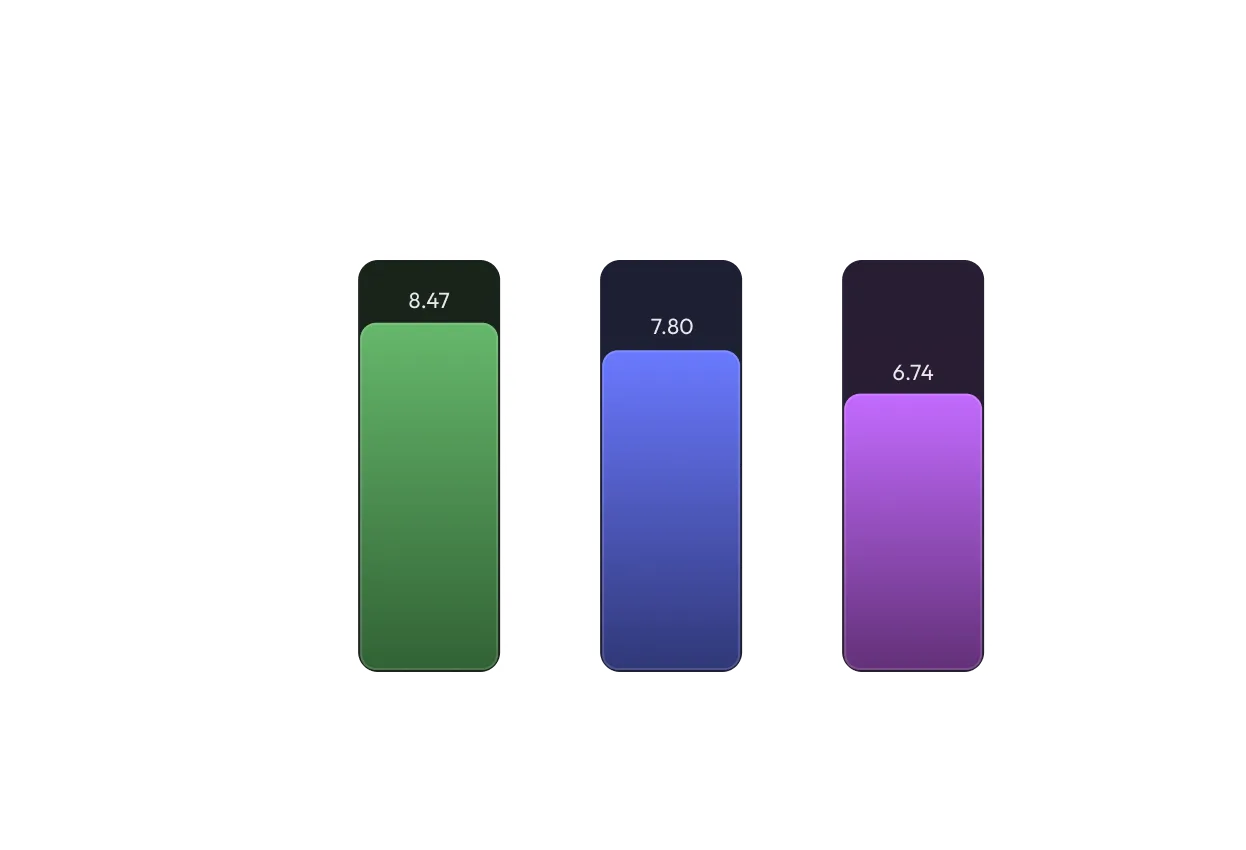
This indicates that the system consistently returns relevant candidates, particularly at the top of the result set.
Key Insights from Human Evaluation
However, deeper human evaluation reveals several critical patterns:
Relevance does not guarantee satisfaction
In 52 cases, evaluators rated ranking poorly despite strong top results. This highlights a gap between raw relevance and perceived quality.
Domain performance varies significantly
The system performs best on technical roles with explicit skill signals, and struggles with roles requiring contextual or soft-skill interpretation (e.g., hospitality, healthcare, logistics).
Over-returning is a dominant failure mode
44% of searches returned large sets where even low-ranked candidates were strong matches . This reduces prioritization and increases cognitive load.
Impact
This QC framework within the micro1 intelligence platform transforms AI Search evaluation from a fragile signal into a reliable system for measuring real-world performance.
By grounding evaluation in actual recruiter behavior, micro1 is able to:
- Recruiters evaluate as practitioners, not labelers
- Metrics reflect actual workflow performance
- Model comparisons remain valid across versions
- Product decisions are based on clean, trustworthy data
Most importantly, human evaluation reveals insights that directly shape product development:
- Improving ranking requires better prioritization, not just relevance
- Systems must provide explanations to build user trust
- Performance must be measured in terms of decision efficiency, not just accuracy
These findings enable micro1 to move beyond traditional evaluation metrics and build AI Search systems that align with how recruiters actually work. In doing so, evaluation becomes not just a measurement tool, but a core driver of product quality and user experience.
.webp)
